Xiaomi just made every other power bank look bloated. The Xiaomi UltraThin Magnetic Power Bank is 6mm thick — thinner than most smartphone cases — and weighs just 98 grams. It launched in early 2026, quietly at first, and then the internet noticed. Now it’s the most talked-about portable charger of the year.
That’s not hyperbole. The thing is genuinely remarkable to hold.
Why 6mm Is a Bigger Deal Than It Sounds
Most power banks are a compromise. They work fine, but you feel them in your pocket — a brick that drags your day down. Xiaomi’s UltraThin sidesteps that entirely. At 6mm, it’s thinner than the iPhone 16 Pro (which clocks in at 8.25mm). You snap it magnetically to the back of your phone and it practically disappears.
The secret is the battery chemistry. Xiaomi ditched standard lithium polymer cells and switched to a silicon-carbon battery with 16% silicon content. Silicon-carbon cells pack more energy into less space — that’s how you get 5,000 mAh in something this thin. It’s the same shift happening in EV batteries, just miniaturized for your pocket.
Frankly, most companies wouldn’t bother. Engineering a custom battery for a $60 accessory takes resources that don’t always pay off at retail. Xiaomi did it anyway, and it shows.
Charging: Fast Enough, Flexible Enough
Snap it on magnetically and you get up to 15W wireless charging — or 7.5W if you’re on an iPhone. Plug in via USB-C and it bumps to 22.5W wired. You can charge two devices simultaneously, which is a nice touch for anyone juggling a phone and earbuds.
One thing worth knowing before you buy: magnetic alignment like this depends on your phone actually having magnets to match. iPhone 12 and newer handle that natively through MagSafe. Android owners typically need a magnetic ring case or a phone with built-in magnetic support — without one, the power bank still charges fine over USB-C, it just will not snap into place or deliver wireless power. It is a detail that trips up a lot of first-time buyers.
Thick cases are the enemy of any magnetic charger, not just this one. A rugged, multi-layer case will weaken the alignment and slow the wireless charging speed no matter which power bank is doing the work.
What it won’t do: rescue you after a week off the grid. A single 5,000 mAh charge gets you roughly one full top-up for most flagship phones. That’s the trade-off for the slim design, and it’s a fair one. This isn’t a high-capacity charger — it’s peace-of-mind power for a long day, a night out, or a cross-country flight.
Build Quality That Punches Above Its Price
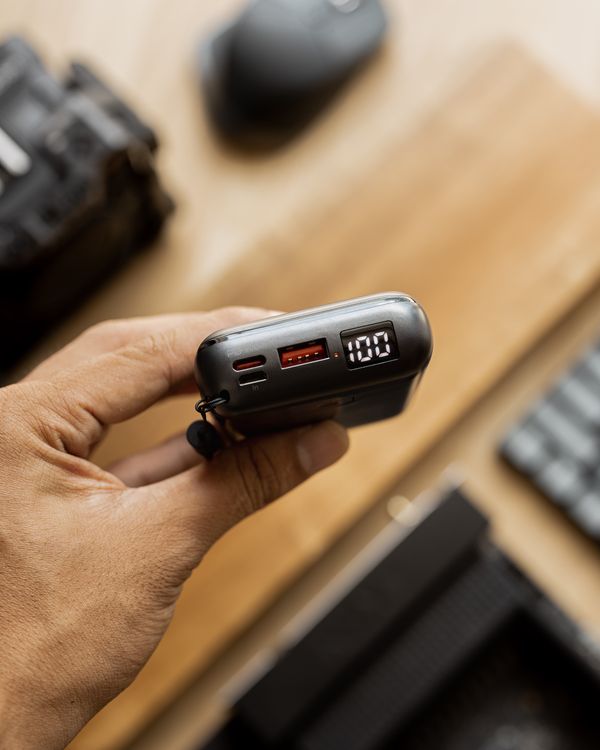
The shell is aluminum alloy with a smooth metallic finish. The phone-facing surface uses fire-resistant fiberglass — a detail that matters more than most buyers realize, since heat management near a battery is genuinely important. There’s no flex, no creaking plastic, no budget-tier wobble when you press on it.
It launched first in Japan, then rolled out to the UK and parts of Europe through early 2026, with pricing landing in the $50–70 range depending on where you buy. US availability has been the main point of frustration for buyers — stock has been inconsistent, and grey-market markups push the price higher. It’s worth waiting for official stock rather than overpaying.
Who Should Actually Buy This
If you regularly run your phone down before the day ends and want something that doesn’t ruin the feel of your device, this is the one. It’s designed for the daily carry crowd — commuters, travelers, people who hate pockets full of gear. It attaches cleanly, charges properly, and gets out of the way.
If you need a 20,000 mAh workhorse that keeps multiple devices alive on a camping trip, look elsewhere. The UltraThin isn’t competing with those. It’s competing with the idea that portable charging has to be uncomfortable — and on that front, it wins easily.
Xiaomi doesn’t always get credit in the Western market for genuine hardware innovation. This one deserves it. A 6mm power bank that actually works well isn’t a gimmick. It’s what the category should have looked like years ago.
For more gadget coverage, see 5 Viral Tech Gadgets Everyone’s Suddenly Obsessed With and iPhone 18 Pro: Rumored Features. For more, visit our Tech & Gadgets section.
Sources and reporting
This article uses Xiaomi’s official product specifications for the 6 mm thickness, weight, battery capacity, charging rates, compatibility, and safety qualifications.
What to verify before buying
A very thin power bank can be convenient, but thickness alone does not establish capacity, charging speed, safety or travel suitability. Product names and specifications may differ by market, so buyers should use Xiaomi’s regional product page and the model number printed on the device or packaging.
- Capacity: compare rated battery capacity with the lower usable output after conversion losses.
- Power: confirm supported input and output standards, cable limits and whether fast charging works with your device.
- Safety: look for required regional certification, protections and an intact manufacturer warranty.
- Air travel: check the watt-hour rating and the current airline and aviation-authority rules; power banks generally belong in carry-on baggage, not checked luggage.
- Seller: avoid listings that omit the exact model, certification markings, return policy or realistic specifications.
Who benefits from the design
The strongest use case is portability: a slim backup that is easier to carry beside a phone. Buyers who need several full recharges, laptop charging or maximum value per watt-hour may be better served by a thicker, higher-capacity model. Availability and pricing are date- and region-sensitive and should not be inferred from launch coverage alone.

Leave a Reply